
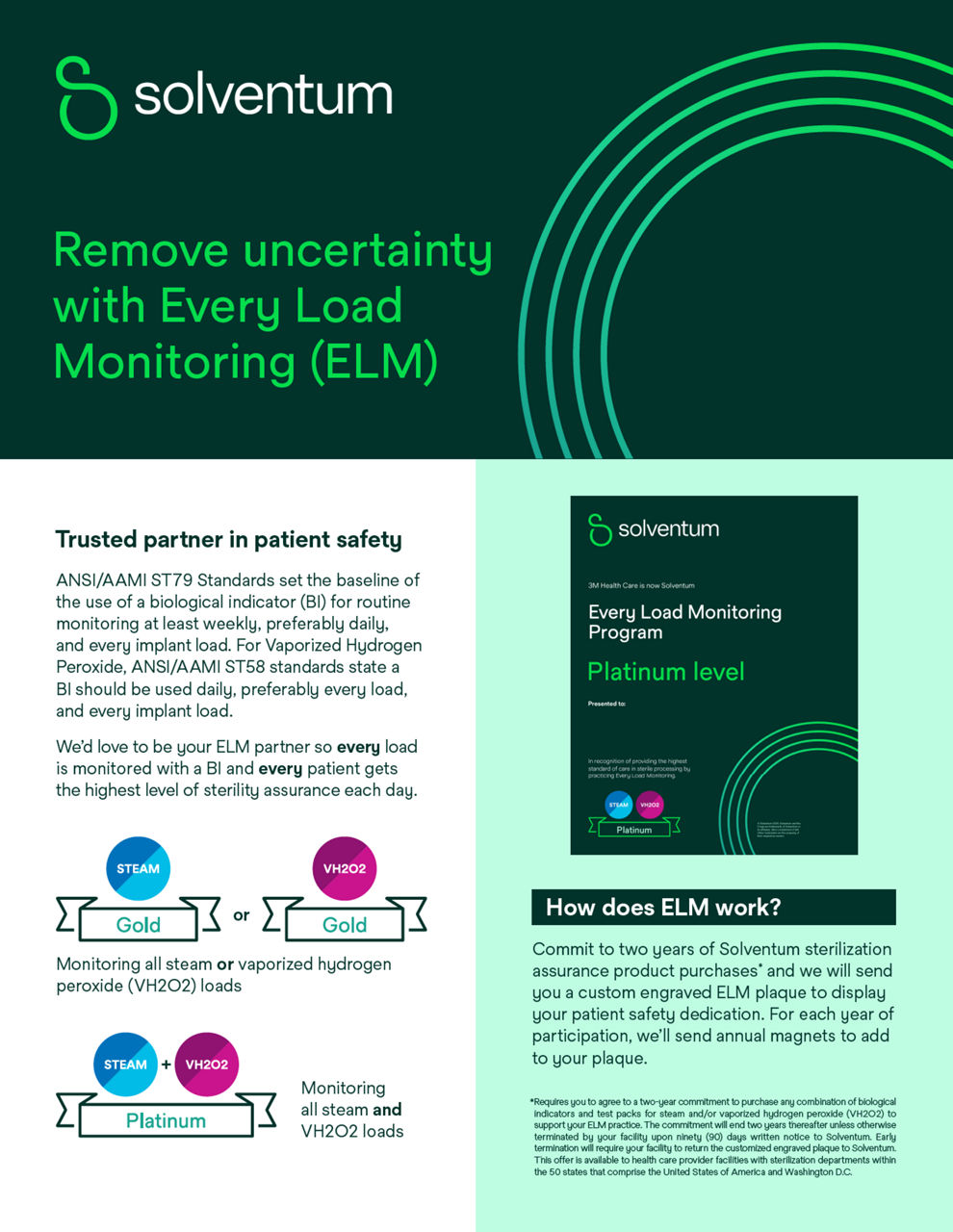
We define Every Load Monitoring (ELM) as the practice of monitoring every steam and VH2O2 sterilization load with a biological indicator (BI) inside a process challenge device (PCD) to verify sterilization effectiveness for every load, every procedure, and every patient.
Every Load Monitoring
Understanding Every Load Monitoring

Monitoring every load provides a consistent level of sterility assurance across all patients and procedures, helps reduce uncertainty, and can simplify investigations if a sterilization failure or suspected infection occurs.
Load monitoring helps provide evidence that sterilization conditions were achieved for every load, helping reduce the risk of unsterile instruments reaching patients.
When every load is monitored consistently with a BI, healthcare facilities can identify issues sooner, respond more quickly, and strengthen compliance with sterilization best practices.
When every load is not monitored with a BI, facilities may face greater uncertainty if a sterilization failure or suspected infection1 occurs.
In some situations, teams may need to trace and evaluate instrument loads back to the last documented negative BI result, potentially requiring additional investigation, reprocessing and workflow disruptions. Uncertainty regarding BI results could also affect clinical operations or lead to recalls.2,3.
Monitoring every load helps strengthen documentation and supports more informed decision-making when questions arise.
Learn more about ELM and see how the standards give guidance on steam and VH2O2 BI load monitoring.
Why current monitoring may have gaps

Steam and VH202 sterilization are both critical to sterile processing. However, routine biological monitoring practices may vary. VH202 sterilization is commonly used for heat and moisture-sensitive medical devices used for patients, making Every Load Monitoring an important consideration in this setting.
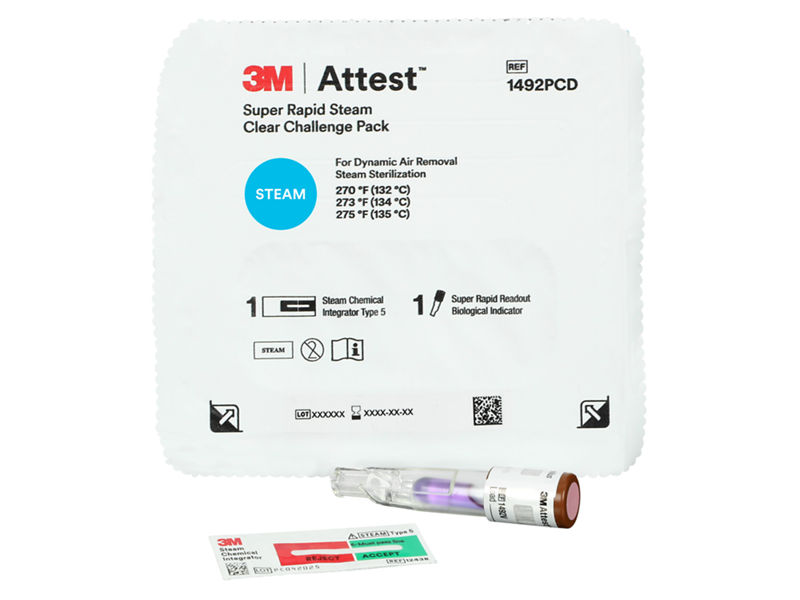
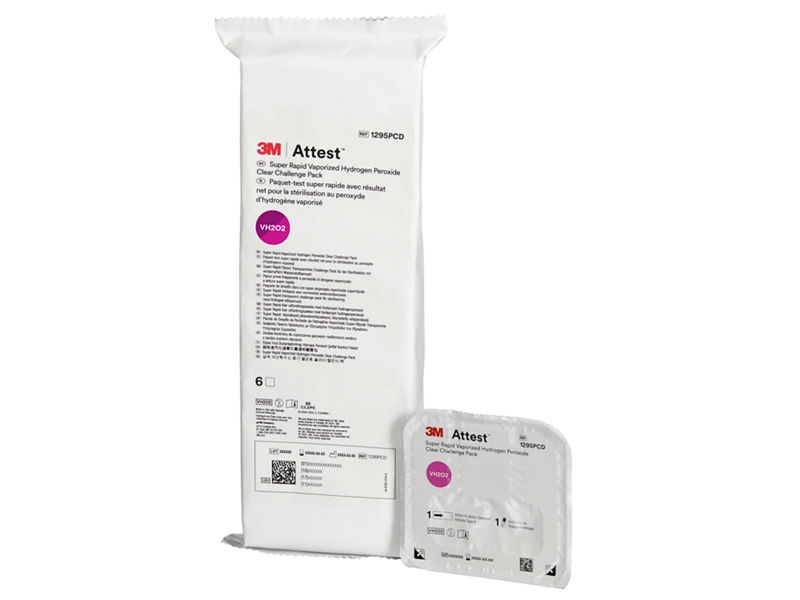
3M™ Attest™ Clear Challenge Packs contain super-rapid biological indicators (BIs) and Type 5 (steam) or Type 4 (VH2O2) chemical indicators (CIs) with independent BSI Kitemark™ certification, helping facilities standardize Every Load Monitoring with confidence.
Compare the common process with ELM process
How to implement ELM

1. Standardize ELM processes
- Require a biological indicator (BI) process challenge device (PCD) for every steam and VH2O2 sterilization load
- Standardize monitoring protocols across sterilization methods
- Align sterile processing, infection prevention, and quality teams around a shared approach
2. Train teams and measure progress
- Educate teams on the why and how of ELM
- Monitor compliance and adoption
- Track recalls and investigations
- Measure process consistency over time
3. Choose products that support your goals
- Find easy to use products
- Promote consistency
- Help standardize workflows
- Simplify monitoring with an all-in-one approach
Our Attest™ Clear Challenge Packs help streamline Every Load Monitoring by combining a process challenge device, super-rapid biological indicator and Type 5 (steam) or Type 4 (VH2O2) chemical indicator into a single solution.
Products that support ELM
Solventum Attest™ products help simplify the Every Load Monitoring process by improving consistency, standardization, and workflow efficiency.
Expert advice & clinical evidence
Explore the evidence, best practices, and practical considerations behind Every Load Monitoring and its potential role in supporting patient safety.
How we earn your trust
FAQs
Biological indicators (BIs) are widely recognized as the most direct measure to monitor effectiveness of sterilization process monitoring because they directly challenge the process with highly resistant bacterial spores called Geobacillus stearothermophilus. When a BI demonstrates successful sterilization conditions, healthcare teams gain added confidence that the process achieved the intended lethality needed to support sterilization assurance and patient safety.
Current standards generally establish minimum monitoring frequencies. Every Load Monitoring goes beyond these minimum recommendations by including biological monitoring with every load, supporting consistent sterility assurance. See the table below for examples of how current standards and guidelines for load monitoring frequency vary.
| Organization | Guidence for Steam BI Load Monitoring | Guidence for VH2O2 BI Load Monitoring |
|---|---|---|
| ANSI/AAMI4,5 | ST79 (Steam): Use a BI in a PCD for routine efficacy monitoring at least weekly, preferably daily; monitor every load containing implants with a BI + Class 5 integrator in a PCD and quarantine implants until the BI is negative. | ST58 (VH2O2): Use a PCD with the appropriate BI at least daily; many facilities implement every-cycle BI monitoring. Follow the sterilizer manufacturer's IFU for BI/PCD type and placement. |
| AORN6 | Policy/guideline materials: Use BIs at least weekly, preferably daily; do not release loads with implants until the BI is negative. | Follow manufacturer IFUs for low-temperature processes; routine daily (preferably each load) monitoring is commonly implemented in perioperative settings, with AAMI ST58 as the technical basis. |
| APIC7 | Aligns with CDC/AAMI practice: BI (spore) testing at least weekly for each sterilizer and in every load with implantable items. | Refers users to AAMI ST58 for VH₂O₂ (at least daily; many facilities choose every-cycle) and to manufacturer IFUs. |
| CDC8 | Steam and low-temperature sterilizers should be monitored at least weekly with the appropriate commercial preparation of spores. If a sterilizer is used several loads per day, daily use of biological indicators allows earlier discovery of problems and minimizes the extent of patient surveillance. Each load should be monitored if it contains implantable objects. | Steam and low-temperature sterilizers should be monitored at least weekly with the appropriate commercial preparation of spores. If a sterilizer is used several loads per day, daily use of biological indicators allows earlier discovery of problems and minimizes the extent of patient surveillance. Each load should be monitored if it contains implantable objects. |
| HSPA9 | Echoes ST79: BI testing at least weekly, preferably daily; Bowie-Dick daily for dynamic-air-removal; manage implants per AAMI ST79. | Education aligns with AAMI ST58 for VH₂O₂ (routine BI use as part of the QA program). |
| World Health Organization (WHO)10 | Sterilization should be monitored with BIs at least daily, CIs (each package), and physical indicators (each cycle). Loads containing an implantable device should be monitored with an additional biological indicator and quarantined until the results are available. Additional monitoring of pre-vacuum sterilizers should include a dynamic air removal test daily. | Sterilization should be monitored with BIs at least daily, CIs (each package) and physical indicators (each cycle). |
Requirements vary by sterilization method and applicable guidelines. Many facilities monitor monitor every implant load and selected loads, while Every Load Monitoring applies biological monitoring to every cycle to provide consistent verification for every load. We recommend all healthcare facilities adopt Every Load Monitoring processes to help increase confidence in their sterilization assurance practices.
If a sterilization failure occurs, facilities may need to investigate or recall loads back to the last documented negative BI result. Less frequent biological monitoring can increase uncertainty during infection investigations and make it more difficult to rule out sterile processing as a potential source.
Solventum has been advancing sterilization assurance innovation for over 70 years, helping healthcare facilities improve confidence in their monitoring processes. Our latest biological indicators (BIs), chemical indicators (CIs), including those contained in our newest process challenge devices (PCDs), undergo rigorous testing and validation, including independent BSI Kitemark™ certification.
Attest products are compatible with many commonly used sterilizers, helping facilities standardize sterilization assurance practices without being tied to a specific equipment manufacturer. It's all part of our commitment to never stop solving for healthcare professionals and the patients they serve.
Chemical indicators (CIs) including Bowie-Dick tests, biological indicators (BIs), and some test packs can carry two very different marks of assurance. Understanding the difference helps your sterile processing department (SPD), infection prevention, and value-analysis teams choose products that have undergone independent third-party verification:
- FDA 510(k) clearance is mandatory — a manufacturer cannot legally market a chemical indicator (CI), biological indicator (BI), or process challenge device (PCD/test pack) in the United States without it.
- BSI Kitemark™ is voluntary — and is third-party verification that the manufacturer's ongoing production consistently meets the ISO performance standards. This annual testing is conducted annually at the manufacturer's facility by BSI Kitemark auditors and assessed against the relevant ISO standards.
Products that carry both FDA 510(k) clearance and BSI Kitemark certification give SPD teams confidence that the products perform consistently as stated by the manufacturer.
Sterile Processing Manager FAQs
Many departments assume cost is the primary barrier. However, the cost of additional monitoring should be weighed against the potential impact of recalls, reprocessing, workflow disruptions, investigations and other corrective actions that may follow a sterilization concern. The broader costs associated including operational, financial and organizational considerations should be accounted into the overall risk evaluation.
The investment required to implement Every Load Monitoring is often lower than expected, when evaluated on a per-patient basis.
Many facilities find that standardizing one process for every load can simplify training, reduce practice variation, and help minimize opportunities for human error. In addition, ELM provides biological monitoring data for each load, helping to limit the scope of load recalls, supporting traceability, investigation activities and quality assurance processes if sterilization concerns occur.
Applying consistent sterility assurance principles across modalities including both steam and VH2O2 can support standardized monitoring practices. We recommend standardizing the processes by consistently using Attest™ Clear Challenge Pack PCDs.
We believe every patient deserves the same level of confidence in instrument sterility. Limiting biological monitoring to implant loads means not every patient receives the same level of sterility verification.
Infection Prevention FAQs
ELM helps provide documented verification of sterilization effectiveness for every monitored load, strengthening quality assurance and supporting infection prevention efforts.
Monitoring every load creates more complete sterilization documentation, which may help facilities assess whether sterile processing could be a contributing factor during an investigation.
ELM helps ensure every patient receives the same level of sterilization monitoring rather than limiting this level of assurance to selected loads
Learn more about us
Footnotes:
- Rutala WA, Weber DJ, “Risk of Disease Transmission to Patients From ‘Contaminated’ Surgical Instruments and Immediate-Use Steam Sterilization.” American Journal of Infection Control, 2023;51(11S):A72-A81. doi:10.1016/j.ajic.2023.01.019.
- Curtis J Donskey, Marian Yowler, Yngve Falck-Ytter, Sirisha Kundrapu, Robert A Salata and William A Rutala, “A case study of a real-time evaluation of the risk of disease transmission associated with a failure to follow recommended sterilization procedures,” Antimicrobial Resistance & Infection Control, 2014, 3:4 http://www.aricjournal.com/content/3/1/. https://www. researchgate.net/publication/259845846 - A case study of a real-time evaluation of the risk of disease transmission associated with a failure to follow recommended sterilization procedures/ fulltext/54914b470cf2d1800d87dc07/259845846 – A case study of a real time evaluation of the risk of disease transmission associated with a failure to follow recommended sterilization procedures.pdf, https://europepmc.org/article/MED/24447336.
- Rose Seavey, MBA, BS, RN, CNOR, CRCST, CSPDT, “Troubleshooting failed sterilization loads: Process failures and wet packs/loads.” American Journal of Infection Control e29-e34. May 02, 2016. Volume 44, Issue 5, Supplement , https://www.ajicjournal.org/article/S0196-6553(16)00201 7/abstract.
- Association for the Advancement of Medical Instrumentation. Comprehensive guide to steam sterilization and sterility assurance in health care facilities. ST79. (2017).
- APIC. “Disinfection and Sterilization — APIC.” Published 2019. https://apic.org/resources/topic-specific-infection-prevention/disinfection-and-sterilization/Association of periOperative Registered Nurses (AORN). Guidelines for Perioperative Practice. 2026 ed. Denver, CO: AORN, Inc.; 2026.
- ANSI/AAMI ST58:2024 Chemical Sterilization and High-Level Disinfection In Health Care Facilities.
- Association of periOperative Registered Nurses (AORN). Guidelines for Perioperative Practice. 2026 ed. Denver, CO: AORN, Inc.; 2026.
- William A Rutala, David J Weber, and the Healthcare Infection Control Practices Advisory Committee (HICPAC), “Guideline for Disinfection and Sterilization in Healthcare Facilities, 2008,” (June 2024): 77-78, https://www.cdc.gov/infection-control/media/pdfs/GuidelineDisinfection-H.pdf.
- Healthcare Sterile Processing Association, Sterile Processing Technical Manual (CRCST 9th Edition). January 1, 2023.
- WHO Library Cataloguing-in-Publication Data, “Decontamination and Reprocessing of Medical Devices for Health-care Facilities,” (2016): 98-99, https://iris.who.int/server/api/core/bitstreams/d128e952-f919-4462-bdb0-392312908782/content.