3M V.A.C.® Therapy

Why V.A.C® Therapy System?
Wound healing is a process. Proper wound management is important to promoting tissue granulation and overall healing. To achieve successful wound healing from start to finish, you need a proven solution.
The 3M™ V.A.C.® Therapy System was introduced in 1995 as the first commercial NPWT system. It has remained at the forefront of negative pressure wound technology, empowering caregivers and benefiting patients worldwide. It is indicated for patients with chronic, acute, traumatic, sub-acute and dehisced wounds, partial-thickness burns, ulcers (such as diabetic, pressure or venous insufficiency), flaps and grafts and closed surgical incisions.
Clinical evidence overwhelmingly supports the efficacy of the V.A.C.® Therapy System. It is designed and clinically demonstrated to create an environment that promotes wound healing. By preparing the wound bed for closure, reducing edema, promoting granulation tissue formation, promoting perfusion and removing exudate and infectious material, this therapy contributes to optimal clinical outcomes.

Proven results of V.A.C.® Therapy
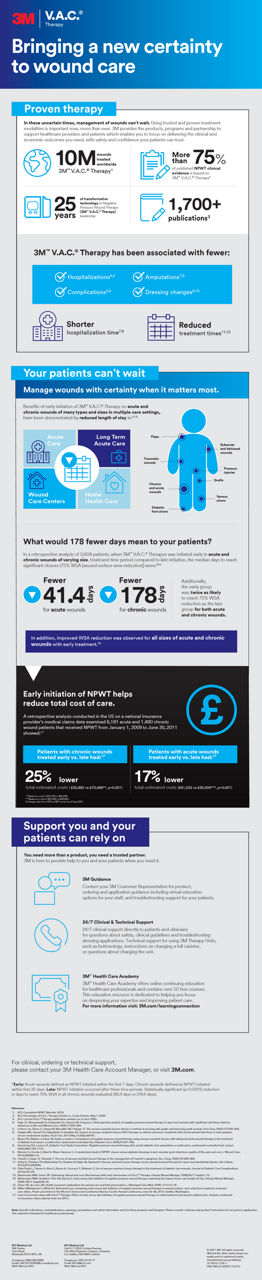
There are over 2,000 peer-reviewed studies4 which have evaluated the effectiveness of V.A.C.® Therapy in a variety of settings and indicated wound types. Comparative studies have shown that V.A.C.® Therapy has been associated with:
- Fewer hospitalisations2,5
- Fewer complications5,6
- Fewer amputations7,8
- Fewer dressing changes9,10
- Faster time to wound healing11
- Shorter hospitalisation7,8
- Reduced treatment times12,13
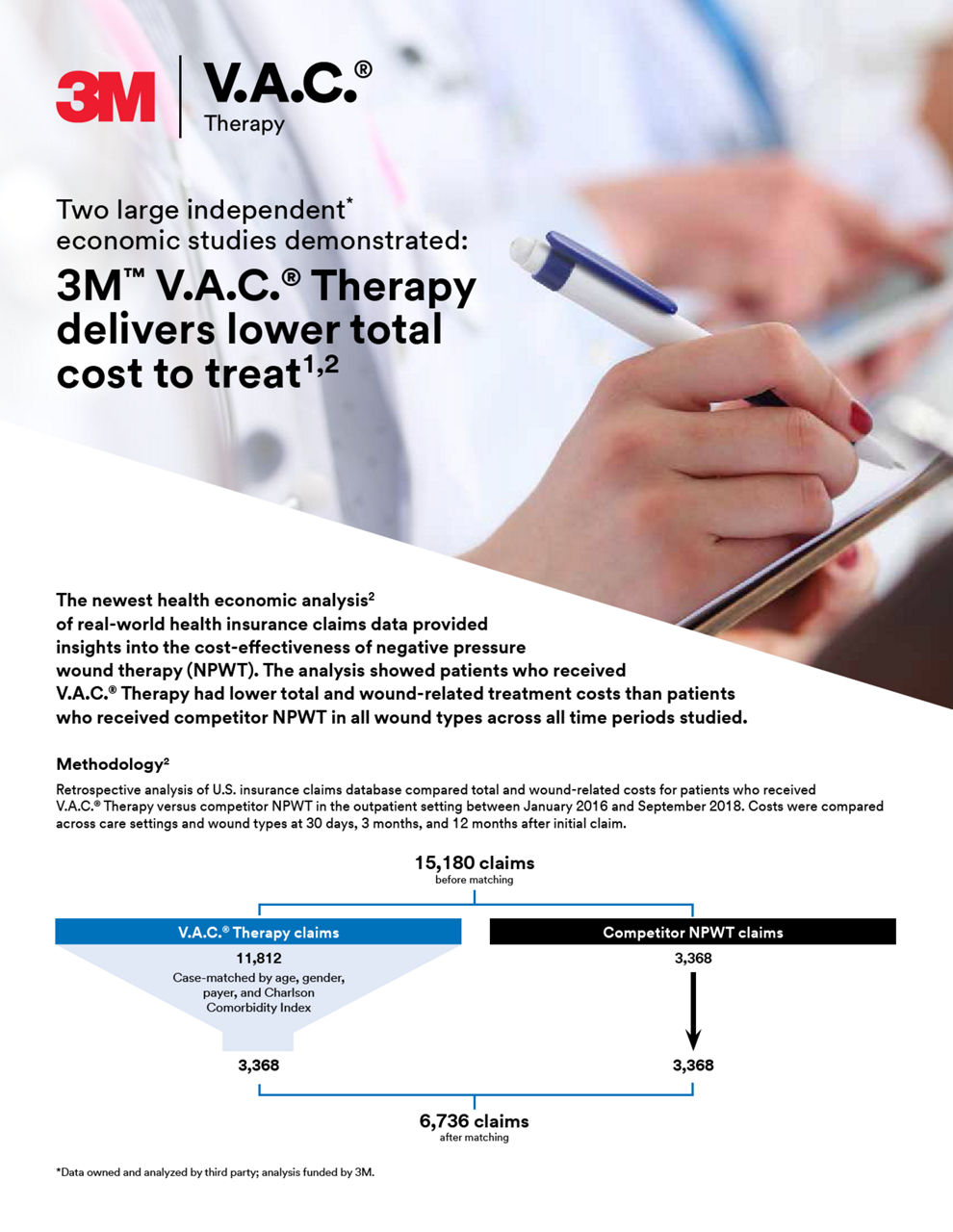
By reducing the factors that contribute to direct and indirect wound care costs, V.A.C.® Therapy has emerged as a cost-effective option for wound management.

V.A.C.® Therapy: How-to videos
Explore our video series covering all aspects of the V.A.C.® Therapy, including an overview about V.A.C.® Therapy, tips for applying V.A.C.® Dressings using the "mushroom" technique on small wounds, safety information and more.
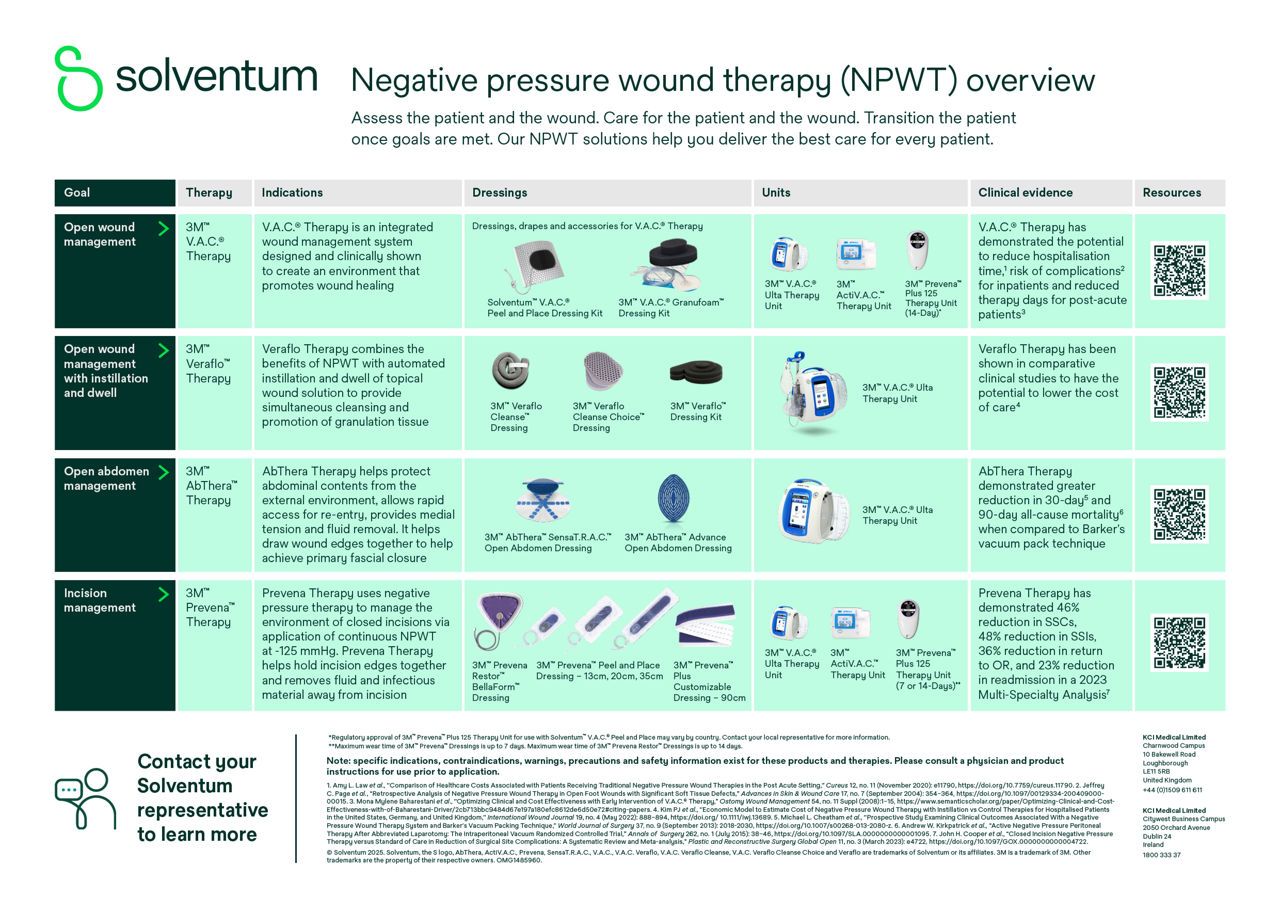
Therapy unit options to deliver V.A.C.® Therapy
Choose from a wide variety of therapy units that meet the clinical and outcome goals of different patients and different types of wounds.


3M V.A.C.® Dressings
From dressings to kits, we have NPWT solutions to promote wound healing.


Solventum™ V.A.C.® Peel and Place Dressing Kit
Easier and faster application of V.A.C.® Therapy is here. V.A.C.® Peel and Place Dressing is the first V.A.C.® Therapy dressing with up to 7-days of wear time1. An all-in-one integrated design streamlines application, reduces the time and training required for dressing changes and maximises consistency of care throughout the patient journey.
- Up to 7-Day Wear Time1
- Average 2-Minute Application2
- Consistent Care Across Settings
1. SAT-BSER-05-869347 VAC Peel and Place BSER. 510(k) K222859.
2. In a simulated use test with 12 nurse and surgeon users. Average time of 01:48. SAT-MTF-05-995965 Marketing study for 3M V.A. C. Peel and Place dressing. 2023.
Resources
Explore more

References:
- 3M. Cumulative NPWT Wounds. 2018.
- Page JC, Newsander B, Schwenke DC, Hansen M, Ferguson J. Retrospective analysis of negative pressure wound therapy in open foot wounds with significant soft tissue defects. Adv Skin Wound Care. 2004;17(7):354-364
- Law A L. Krebs B. Karnik B. Griffin L. Comparison of Healthcare Costs Associated With Patients Receiving Traditional Negative Pressure Wound Therapies in the Post Acute Setting. Cureus 12(11): e11790.
- KCI. Percentage of V.A.C. Therapy Articles vs. Comp Articles. May 7, 2020.
- Scherer, L.A.; Shiver, S.; Chang, M.; Meredith, J.W.; Owings, J.T. The vacuum assisted closure device: a method of securing skin grafts and improving graft survival. Arch. Surg. 2002; 137:930-934.
- Falagas, M.E.; Tansarli, G.S.; Kapaskelis, A.; Vardakas, K.Z. Impact of vacuum-assisted closure (VAC) therapy on clinical outcomes of patients with sternal wound infections: a meta-analysis of non-randomized studies. PLoS One. 2013 May 31; 8(5):e64741.
- Blume, P.A.; Walters, J.; Payne, W.; Ayala, J.; Lantis, J. Comparison of negative pressure wound therapy using vacuum-assisted closure with advanced moist wound therapy in the treatment of diabetic foot ulcers: a multicenter randomized controlled trial. Diabetes Care. 2008; 31:631-636.
- Armstrong, D.G.; Lavery, L.A. Diabetic Foot Study Consortium. Negative pressure wound therapy after partial diabetic foot amputation: a multicentre, randomised controlled trial. Lancet. 2005;366:1704-1710.
- Monsen, C.; Acosta, S.; Mani, K.; Wann-Hansson, C. A randomised study of NPWT closure versus alginate dressings in peri-vascular groin infections: quality of life, pain and cost. J. Wound Care. 2015; 24:252-260.
- Ozturk, E.; Ozguc, H.; Yilmazlar, T. The use of vacuum assisted closure therapy in the management of Fournier's gangrene. Am. J. Surg. 2009; 197:660-665.
- Yao, M.; Fabbi, M.; Hayashi, H.; et al. A retrospective cohort study evaluating efficacy in high-risk patients with chronic lower extremity ulcers treated with negative pressure wound therapy. International Wound Journal. 2014; 11:483-488.
- Sinha, K.; Chauhan, V.D.; Maheshwari, R.; Chauhan, N.; Rajan, M.; Agrawal, A. Vacuum assisted closure therapy versus standard wound therapy for open musculoskeletal injuries. Adv Orthop. 2013; 2013:245940.
- Dalla, Paola, L.; Carone, A.; Ricci, S.; Russo, A.; Ceccacci, T.; Ninkovic, S. Use of vacuum assisted closure therapy in the treatment of diabetic foot wounds. Journal of Diabetic Foot Complications. 2010; 2:33-44.
- Orgill DP, Manders EK, Sumpio BE, et al. The mechanisms of action of vacuum assisted closure: more to learn. Surgery. 2009 Jul;146(1):40-51.
- Saxena V, Hwang CW, Huang S, Eichbaum Q, Ingber D, Orgill DP. Vacuum-assisted closure: microdeformations of wounds and cell proliferation. Plast Reconstr Surg. 2004 Oct;114(5):1086-96; discussion 1097-8.
- McNulty AK, et al. Effects of negative pressure wound therapy on the fibroblast viability, chemotactic signaling and proliferation in a provisional wound (fibrin) matrix. WOUNDS. 2007; 15:838-‐846.