3M V.A.C.® 治療

為什麼選擇V.A.C®治療系統?
傷口癒合是一個過程。適當的傷口管理對於促進組織肉芽生成和整體癒合非常重要。要從始至終實現成功的傷口癒合,您需要一個經過驗證的解決方案。
3M™ V.A.C.®治療系統於1995年作為首個商用NPWT系統推出。它一直位於負壓傷口技術的最前線,賦予主要照護者權力並使全球患者受益。它適用於患有慢性、急性、創傷性、亞急性和裂開傷口、部分厚度燒傷、潰瘍(如糖尿病、壓力或靜脈不全)、瓣膜和移植物以及封閉的外科切口的患者。
臨床證據極力支持V.A.C.®治療系統的功效。它被設計並在臨床上證明能創造一個促進傷口癒合的環境。通過準備傷口床進行關閉、減少水腫、促進肉芽組織形成、促進灌注並移除滲出物和感染物質,此治療有助於實現最佳臨床成果。

V.A.C.® 治療的驗證成效
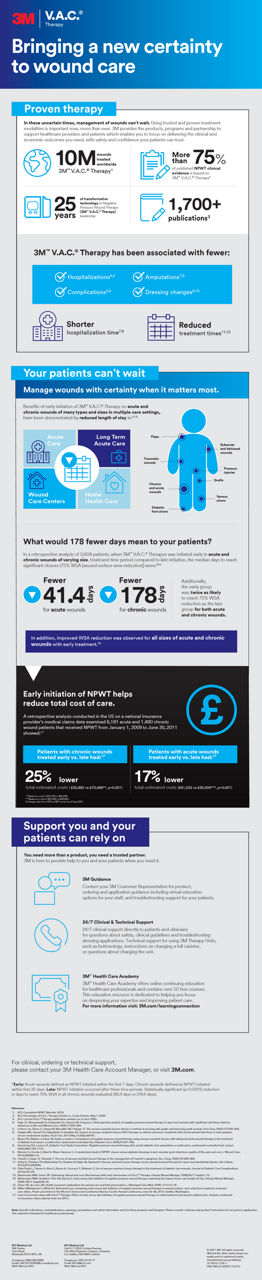
有超過 2,000 篇同行評審的研究4 評估了 V.A.C.® 治療在各種環境和指定傷口類型的有效性。比較研究表明 V.A.C.® 治療與下列情況相關:
- 較少的住院次數2,5
- 較少的併發症5,6
- 較少的截肢7,8
- 較少的換藥次數9,10
- 傷口癒合時間更快11
- 住院時間更短7,8
- 治療時間減少12,13
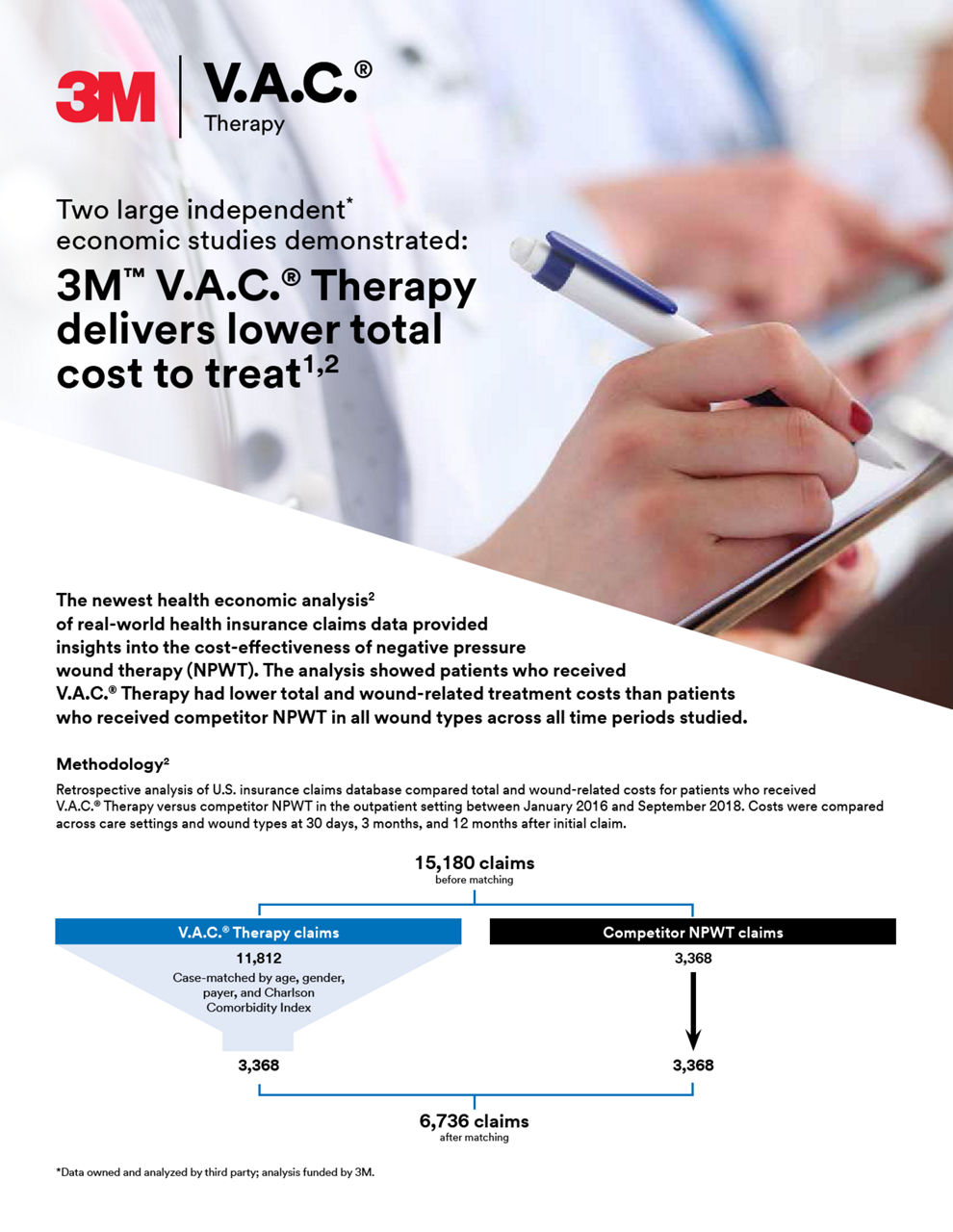
通過減少直接和間接傷口護理成本的因素,V.A.C.® 治療已成為傷口管理的具成本效益的選擇。

V.A.C.® 治療:操作教學影片
探索我們的影片系列,涵蓋V.A.C.®治療的各個方面,包括V.A.C.®治療的概述、使用“蘑菇頭”技術在小傷口上應用V.A.C.®敷料的技巧、安全信息等等。
用於提供V.A.C.® 治療的治療儀
選擇多種不同的治療儀,以滿足不同病患和不同類型傷口的臨床和治療成果目標。


3M V.A.C.® 裹料
從敷料到套件,我們提供 NPWT 解決方案以促進傷口癒合。


資源
探索更多

參考資料:
- 3M. Cumulative NPWT Wounds. 2018.
- Page JC, Newsander B, Schwenke DC, Hansen M, Ferguson J. Retrospective analysis of negative pressure wound therapy in open foot wounds with significant soft tissue defects. Adv Skin Wound Care. 2004;17(7):354-364
- Law A L. Krebs B. Karnik B. Griffin L. Comparison of Healthcare Costs Associated With Patients Receiving Traditional Negative Pressure Wound Therapies in the Post Acute Setting. Cureus 12(11): e11790.
- KCI. Percentage of V.A.C. Therapy Articles vs. Comp Articles. May 7, 2020.
- Scherer, L.A.; Shiver, S.; Chang, M.; Meredith, J.W.; Owings, J.T. The vacuum assisted closure device: a method of securing skin grafts and improving graft survival. Arch. Surg. 2002; 137:930-934.
- Falagas, M.E.; Tansarli, G.S.; Kapaskelis, A.; Vardakas, K.Z. Impact of vacuum-assisted closure (VAC) therapy on clinical outcomes of patients with sternal wound infections: a meta-analysis of non-randomized studies. PLoS One. 2013 May 31; 8(5):e64741.
- Blume, P.A.; Walters, J.; Payne, W.; Ayala, J.; Lantis, J. Comparison of negative pressure wound therapy using vacuum-assisted closure with advanced moist wound therapy in the treatment of diabetic foot ulcers: a multicenter randomized controlled trial. Diabetes Care. 2008; 31:631-636.
- Armstrong, D.G.; Lavery, L.A. Diabetic Foot Study Consortium. Negative pressure wound therapy after partial diabetic foot amputation: a multicentre, randomised controlled trial. Lancet. 2005;366:1704-1710.
- Monsen, C.; Acosta, S.; Mani, K.; Wann-Hansson, C. A randomised study of NPWT closure versus alginate dressings in peri-vascular groin infections: quality of life, pain and cost. J. Wound Care. 2015; 24:252-260.
- Ozturk, E.; Ozguc, H.; Yilmazlar, T. The use of vacuum assisted closure therapy in the management of Fournier's gangrene. Am. J. Surg. 2009; 197:660-665.
- Yao, M.; Fabbi, M.; Hayashi, H.; et al. A retrospective cohort study evaluating efficacy in high-risk patients with chronic lower extremity ulcers treated with negative pressure wound therapy. International Wound Journal. 2014; 11:483-488.
- Sinha, K.; Chauhan, V.D.; Maheshwari, R.; Chauhan, N.; Rajan, M.; Agrawal, A. Vacuum assisted closure therapy versus standard wound therapy for open musculoskeletal injuries. Adv Orthop. 2013; 2013:245940.
- Dalla, Paola, L.; Carone, A.; Ricci, S.; Russo, A.; Ceccacci, T.; Ninkovic, S. Use of vacuum assisted closure therapy in the treatment of diabetic foot wounds. Journal of Diabetic Foot Complications. 2010; 2:33-44.
- Orgill DP, Manders EK, Sumpio BE, et al. The mechanisms of action of vacuum assisted closure: more to learn. Surgery. 2009 Jul;146(1):40-51.
- Saxena V, Hwang CW, Huang S, Eichbaum Q, Ingber D, Orgill DP. Vacuum-assisted closure: microdeformations of wounds and cell proliferation. Plast Reconstr Surg. 2004 Oct;114(5):1086-96; discussion 1097-8.
- McNulty AK, et al. Effects of negative pressure wound therapy on the fibroblast viability, chemotactic signaling and proliferation in a provisional wound (fibrin) matrix. WOUNDS. 2007; 15:838-‐846.
- SAT-MTF-05-982101 Evaluation of VAC Peel and Place Dressing Concepts in Full-Thickness Excisional Wounds. 2023. Allen D, Robinson T, Schmidt M, Kieswetter K. Preclinical assessment of novel longer-duration wear negative pressure wound therapy dressing in a porcine model. Wound Rep Reg. 2023;31:349-359.