Prevena™ Duo Sistema di gestione delle incisioni
Informazioni sul prodotto
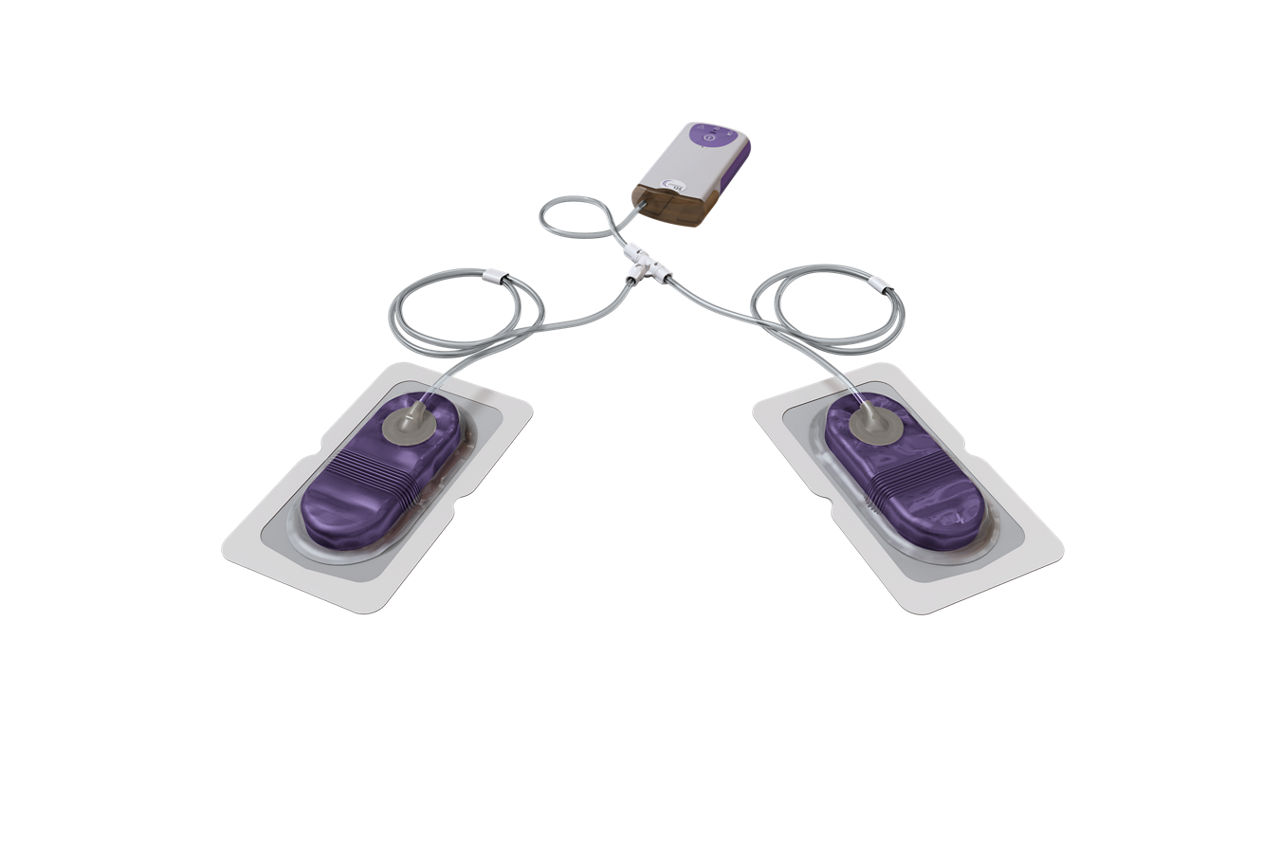
Prevena Duo Sistema di gestione delle incisioni è studiato per gestire due incisioni chirurgiche con un'unità terapeutica ed è ideale per procedure bilaterali. Il sistema di gestione delle incisioni Prevena contiene due Prevena Peel and Place medicazioni per l'utilizzo su incisioni lineari fino a 13 cm di lunghezza. Il sistema portatile può essere facilmente gestito dal paziente a casa fino a 7 giorni, senza necessità di cambi di medicazione.
Dettagli del prodotto
- Studiata per l'uso su due incisioni lineari fino a 13 cm di lunghezza
- Gestisce l'incisione chirurgica chiusa per 7 giorni, senza necessità di cambi di medicazione
- Fornisce una terapia a pressione negativa continua preimpostata a -125 mmHg
- Dispositivo monouso individuale con 3 batterie AA pre-installate (peso 0,4 lb/0,2 Kg; dimensioni 13,6 x 7,5 x 3 cm)
- Contenitore sostituibile da 45 mL (individuale, sterile, monouso)
- Allarmi visivi/acustici per la sicurezza dei pazienti
- PrevenaPeel and Place medicazioni contengono un booster in schiuma per canalizzare la pressione negativa all'area di incisione. Il livello di interfaccia della medicazione delicato sulla cute aiuta ad assorbire fluidi dalla superficie cutanea e contiene 0,019% di argento ionico per ridurre la colonizzazione batterica del tessuto.
- Il paziente può fare la doccia con la medicazione
Legale
¹ Outside US (OUS) Prevena Therapy instructions for use / OUS indication statement ² Wilkes RP, Kilpad DV, Zhao Y, Kazala R, McNulty A. Closed Incision management with negative pressure wound therapy (CIM): biomechanics. Surg Innov. 2012;19(1):67–75. doi:10.1177/1553350611414920. Glaser DA, Farnsworth CL, Varley ES, et al. Negative pressure therapy for closed spine incisions: a pilot study. Wounds. 2012;24(11):308–316. ⁴ Kilpadi DV, Cunningham MR. Evaluation of closed incision management with negative pressure wound therapy (CIM): hematoma/seroma and involvement of the lymphatic system. Wound Repair Regen. 2011;19(5):588–596. doi:10.1111/j.1524-475X.2011.00714.x. 5. Ferrando PM, Ala A, Bussone R, Bergamasco L, Actis Perinetti F, Malan F. Closed incision negative pressure therapy in oncological breast surgery: comparison with standard care dressings. Plast Reconstr Surg Glob Open. 2018 Jun 15;6(6):e1732. doi:10.1097/GOX000000000000173 3. Pleger SP, Nink N, Elzien M, Kunold A, Koshty A, Boning A. Reduction of groin wound complications in vascular surgery patients using closed incision negative pressure therapy (ciNPT): a prospective, randomised, single-institution study. Int Wound J. 2018;15(1):75-83. 4. Cooper HJ, Bas MA. Closed-incision negative-pressure therapy versus antimicrobial dressings after revision hip and knee surgery: a comparative study. J Arthroplasty. 2016 May;31(5):1047-1052. doi:10.1016/j.arth.2015.11.010 5. Redfern RE, Cameron-Ruetz C, O’Drobinak SK, Chen JT, Beer KJ. Closed incision negative pressure therapy effects on postoperative infection and surgical site complication after total hip and knee arthroplasty. J Arthroplasty. 2017;32:3333-3339. doi:10.1016/j.arth.2017.06.019 6. Newman JM, Siqueira MBP, Klika AK, Molloy RM, Barsoum WK, Higuera CA. Use of closed incisional negative pressure wound therapy after revision total hip and knee arthroplasty in patients at high risk for infection: a prospective, randomized clinical trial. J Arthroplasty. 2019 Mar;34(3):554-559e1. doi:10.1016/j.arth.2018 7. Stannard JP, Volgas DA, McGwin G 3rd, et al. Incisional negative pressure wound therapy after high-risk lower extremity fractures. J Orthop Trauma. 2012;26(1):37‐42. doi:10.1097/BOT.0b013e318216b1e5. 8. Grauhan O, Navasardyan A, Hofmann M, et al. Prevention of poststernotomy wound infections in obese patients by negative pressure wound therapy. J Thorac Cardiovasc Surg. 2013;145:1387-1392. 9. Gabriel A, Sigalove S, Sigalove N, et al. The impact of closed incision negative pressure therapy on postoperative breast reconstruction outcomes. Plast Reconstr Surg Glob Open. 2018 Aug; 6(8): e1880.doi:10.1097/GOX.0000000000001880 10. Stannard JP, Volgas DA, McGwin G 3rd, et al. Incisional negative pressure wound therapy after high-risk lower extremity fractures. J Orthop Trauma. 2012;26(1):37‐42. doi:10.1097/BOT.0b013e318216b1e5. 11. Kwon J, Staley C, McCullough M, Goss S, Arosemena M, Abai B, Salvatore D, Reiter D, DiMuzio P. A randomized clinical trial evaluating negative pressure therapy to decrease vascular groin incision complications. J Vasc Surg. 2018 Dec;68(6):1744-1752. doi: 10.1016/j.jvs.2018.05.224. Epub 2018 Aug 17. PMID: 30126781. 12. Gabriel A, Maxwell GP. Economic Analysis Based on the Use of Closed-Incision Negative-Pressure Therapy after Postoperative Breast Reconstruction. Plast Reconstr Surg. 2019 Jan;143(1S Management of Surgical Incisions Utilizing Closed-Incision Negative-Pressure Therapy):36S-40S. doi: 10.1097/PRS.0000000000005311. PMID: 30586102. 13. Gabriel A, et al, Effects of Negative-Pressure Wound Therapy with Instillation versus Standard of Care in Multiple Wound Types: Systematic Literature Review and Meta-Analysis, Plastic & Reconstructive Surgery, 2021 Jan 1;147(1S-1):68S-76S. 14. Gabriel A, Kahn K, Karmy-Jones R. Use of negative pressure wound therapy with automated, volumetric instillation for the treatment of extremity and trunk wounds: clinical outcomes and potential cost-effectiveness. Eplasty. 2014; 14: e41.Specifiche del prodotto
| Lunghezza complessiva (misure imperiali) |
Lunghezza complessiva (misure imperiali)
5.12 in |
| Global Catalog Number |
Global Catalog Number
PRE1121 |
| Marchio |
Marchio
Prevena™ |
| Lunghezza complessiva (misure metriche) |
Lunghezza complessiva (misure metriche)
13 cm |
| Nome categoria |
Nome categoria
Kit NPT |