3M™ Skin and Nasal Antiseptic, 192401
About the product
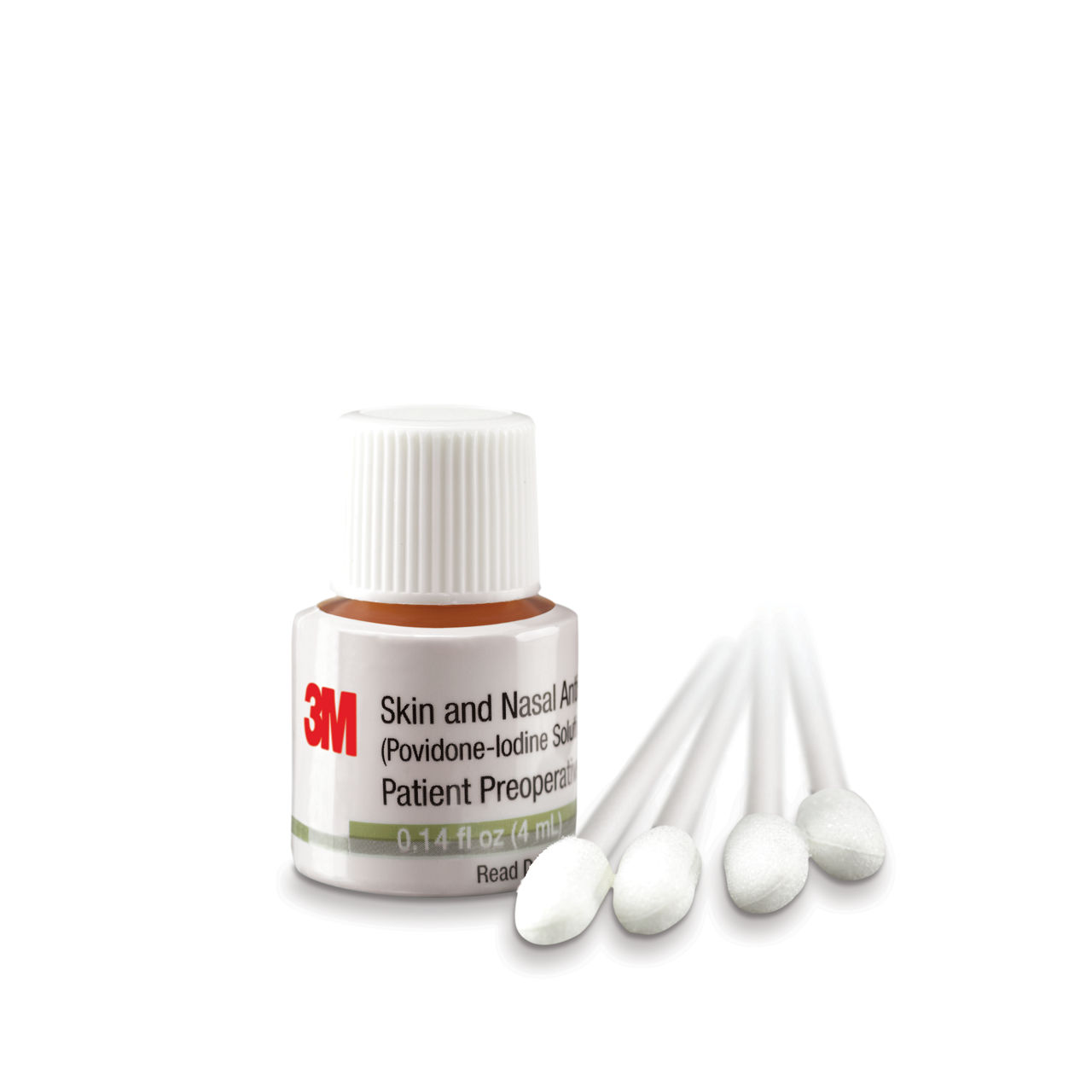
Take control of your pre surgical infection prevention protocol. Apply Skin and Nasal Antiseptic one hour before surgery to reduce bacteria in the nares.⁴
Product details
Control nasal decolonization with a trusted solution.
Skin and Nasal Antiseptic allows facilities to oversee nasal decolonization in their facility, without the complexity of at-home applications before and after surgery.
Frequently, providers address nasal bacteria with a five-day regimen of an antibiotic called mupirocin. However, poor patient compliance and antibiotic resistance can make this treatment less effective. To help protect patients, Skin and Nasal Antiseptic is an alternative antiseptic solution to the current antibiotic approach for nasal decolonization.
This simple, one-time application reduces nasal bacteria, including S. aureus, by 99.5% in just one hour and maintains this reduction for at least 12 hours.
As part of a comprehensive preoperative protocol, Skin and Nasal Antiseptic is an important tool to help reduce SSIs while supporting antibiotic stewardship.2,5,8
- Skin and Nasal Antiseptic:
- A pH-balanced formulation with a scientifically developed film-forming polymer to increase persistence.
- Helps improve patient safety and protocol compliance without alcohol or antibiotics.
- More effective than 10% povidone-iodine for intranasal S. aureus decolonization over the 4 hour time interval (p=0.003).
- Evidence-based solution supported by 10 investigator-initiated studies
Legal
¹ Solventum Study-05-011017; ² Phillips M, Rosenburg A, Shopsin B, et al. Preventing surgical site infections; A randomized, open-label trial of nasal mupirocin ointment and nasal povidone-iodine solution. Infect Control Hosp Epidomiol. 2014;35:826-832.; ³ Rezapoor M, Nicholson T, Patel R, Mostafavi R, Chen AF, Parvizi J. Do iodine-based solutions differ in their effectiveness for decolonizing intranasal Staphylococcus aureus? Presented at the MSIS Annual Meeting, Cleveland, OH, August 2015.; ⁴ Solventum Study-05-011100.; ⁵ Bebko SP, Green DM, Awad SS. Effect of a preoperative decontamination protocol on surgical site infections in patients undergoing elective orthopedic surgery with hardware implantation. JAMA Surg. 15;150:390-295.; ⁶ Brown L, Shelly M, Greene L, et al. The effect of universal intranasal povidone iodine antisepsis on total joint replacement surgical site infections. Presented at the APIC National Conference, Anaheim, CA, June 2014.; ⁷ Waibel ML. Revisiting process improvement for total joint arthroplasty SSI. Presented at the APIC National Conference, Fort Lauderdale, FL, June 2013.; ⁸ Hogenmiller JR, Hamilton J, Clayman T, et al. Preventing orthopedic total joint replacement SSIs through a comprehensive best practice bundle/checklist. Presented at the APIC National Conference, Baltimore, MD, June 2011.Product specifications
| Global Catalog Number |
Global Catalog Number
192401 |
| Category name |
Category name
Patient Skin Prep |
| categoryName |
categoryName
Patient Skin Prep |